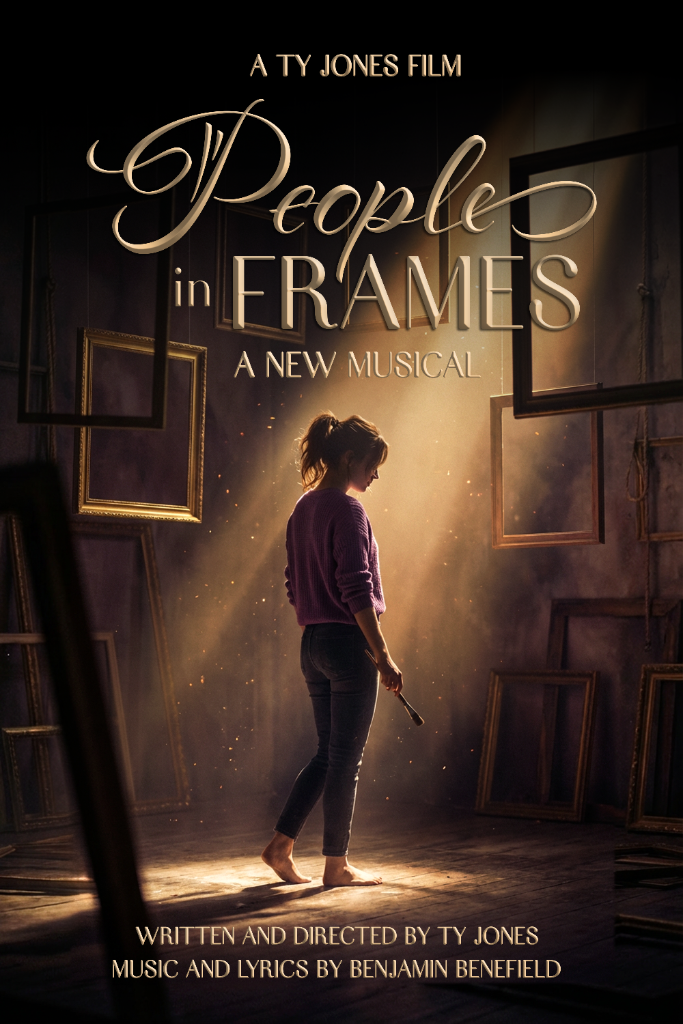
PEOPLE IN FRAMES
People In Frames is a contemporary new musical about a young painter who finds her voice by observing the lives that pass quietly around her. As her talent draws sudden attention and success reshapes her world, she must navigate ambition, love, betrayal, and forgiveness to discover what truly defines her art—and herself. Set against the rhythm of a living city, People In Frames is a moving, intimate story about seeing others, being seen, and learning when to step into your own frame.
Invisible
Chloe's First musical number. After she packs up her stuff and feeds the cat, she goes to the park to pain in various locations. She stops for the day and is on the street and sings about feeling invisible in life.
Stack, Facts and Paperbacks
Introduces Chloe to her new world at the bookstore on her very first day. Brittany—a relentlessly upbeat, bubbly coworker who’s been there for years—insists on giving Chloe an enthusiastic tour of every section, determined to shake her out of her quiet, inward funk. What begins as an awkward, forced moment for Chloe quickly becomes a playful initiation into the rhythm of the store. As Brittany barrels through her cheerful breakdown of genres and customers, Chloe’s attention is unexpectedly pulled to Brandon, a fellow employee whose quiet presence catches her eye—setting the spark for a connection that will grow throughout the story.
Somebody Else's Dream
Outside the quiet glow of the bookstore and later on her apartment balcony that night, Chloe wrestles with the weight of a life that no longer feels like her own. Encouraged by Brittany and Brandon to enter the museum’s portrait competition, she confronts the fear of stepping away from the safe routine she’s been living. Torn between comfort and possibility, the song captures the moment Chloe realizes she’s been chasing someone else’s dream—and begins to consider choosing her own.
People In Frames
People in Frames is a reflective, waltz-like solo in which Chloe escapes to the art museum after her bookstore shift to sketch strangers from every walk of life. As she quietly observes couples, scholars, tourists, and everyday passersby, she captures not just their appearances but the stories she imagines behind their faces. The song reveals Chloe’s deep empathy, her instinct to see beauty in unnoticed moments, and her longing to be seen herself—establishing the emotional heartbeat of the musical and her identity as an artist who finds meaning in ordinary lives.
I Wonder What She Sees
In “I Wonder What She Sees,” Brandon reflects on his growing intrigue with Chloe from a quiet distance. Watching her move through the bookstore with a world clearly alive behind her eyes, he begins to wonder how she interprets everything around her—what colors she notices, what details she lingers on, what stories shape her inner world. The song captures the early spark of connection before love is fully realized: curious, tentative, and full of quiet admiration. Through Brandon’s perspective, we glimpse Chloe not just as a coworker, but as someone extraordinary in the way she sees and feels the world—foreshadowing both their emotional bond and the journey ahead.
Art Is Subject, But You're Wrong
Milo, a razor-sharp, hyper-opinionated painter with a flair for the dramatic, makes his unforgettable entrance with this fast, biting, and wildly entertaining musical manifesto. Positioned as both the intellectual comedian and self-appointed authority of the art world, Milo unapologetically dissects famous artists, movements, and trends with sarcastic precision. With each lyrical jab, he showcases his vast knowledge, impeccable memory, and cutting wit—delighting the audience while subtly establishing his insecurity and obsession with being seen as superior.
The Way You See Me Too
“The Way You See Me” is a mid-tempo rock duet between Chloe and Brandon that captures the quiet electricity of two people seeing each other for the first time, not through fantasy, but through honesty. Rather than a traditional love ballad, the song unfolds as a conversational exchange—each of them revealing how they perceive the other from their own guarded point of view. Chloe is uncertain but curious about being truly noticed; Brandon is drawn to her depth and mystery without fully understanding it yet. The song lives in the space between attraction and trust, where feelings are only just beginning to surface. It marks the emotional foundation of their relationship—subtle, grounded, and real.
The Museum of Art
A Day in the Museum is a vibrant company number set in the grand lobby of the Museum of Art, capturing the constant motion, contradiction, and quiet comedy of its visitors. As Chloe sketches from the sidelines, the museum comes alive with overlapping perspectives: polished curators guarding their legacy, wealthy patrons treating art as status, wide-eyed tourists searching for meaning, and casual “lookie-loos” drifting in and out without a clue what they’re seeing.
The Shape of What I know
Chloe begins the first day of painting her competition portrait. Alone with the canvas, she narrates her process in real time—questioning each line, doubting each decision, then slowly trusting her instincts as the image starts to emerge. The song plays like an intimate inner monologue, revealing how she sees not just the subject she’s painting, but herself. It captures the quiet tension between precision and intuition, frustration and discovery, as Chloe learns to let the work unfold instead of forcing it. This moment marks the true start of her artistic transformation. Day 1 – Discovery “What is this becoming?”
The Critics Table Game
Set immediately after Chloe’s sudden rise to public attention, “The Critics’ Table” is a sharp, self-aware ensemble number led by the three principal judges of the portrait competition. Framed as a stylized debate at a judging table, the song exposes each critic’s personality, bias, and private agenda as they dissect Chloe’s work—and her meteoric success—with cutting wit and theatrical flair.
The Choice
Chloe is stuck in limbo.
You Gotta Roll
This explosive soul-funk number marks the entrance of Chloe’s larger-than-life Art Agent, a man who sells dreams as confidently as he sells himself. Opening with a swaggering spoken-word monologue, he hijacks the room with charisma, spectacle, and unapologetic ambition, positioning himself as the ultimate gatekeeper to fame. Through slick grooves, horn hits, and relentless bravado, he promises Chloe instant stardom, framing her raw talent as a product he alone can properly “package.” The song blurs the line between mentorship and manipulation—equal parts seduction, sales pitch, and self-worship.
Lights In My Name
“All These Lights” captures the dizzying moment Chloe is suddenly thrust from quiet anonymity into the blinding spotlight of high-end success. Fresh off her competition win, she is swept into a glamorous world of galleries, patrons, critics, and cameras—where admiration is loud, constant, and overwhelming. As flashbulbs pop and voices praise her brilliance, Chloe wrestles with the question beneath the celebration: Is this truly who she is, or who they want her to be? The song balances exhilaration with unease, revealing the emotional cost of instant visibility and the fragile line between being seen and being shaped by fame.
I've Already Won
A high-octane, horn-driven funk anthem led by Gordon and his two razor-sharp junior agents, “I’ve Already Won” explodes onto the stage as Chloe is thrust into the high-powered world of commercial art. With swagger, spectacle, and relentless confidence, Gordon boasts of every deal he’s closed, every career he’s engineered, and every rule he’s bent to turn talent into profit. As Chloe struggles to keep up with the speed and scale of this new world, the song becomes both a seductive invitation and a warning—revealing Gordon’s charm, ego, and belief that fame is a game he has already mastered. Flashy, infectious, and dangerously alluring, the number immerses the audience in the glamour and pressure of success-for-sale.
Your Kiss Is Poison
“Kiss Is Poison” is a sultry, conflicted solo for Chloe as she finds herself drawn to Gordon’s charisma and the intoxicating energy of his world—despite her better judgment. Set against a glowing city backdrop, the song captures the tension between desire and intuition, as Chloe wrestles with attraction that feels thrilling but dangerous. With its slow-burn intensity and emotional push-and-pull, the number marks the moment she knowingly steps toward a relationship that promises excitement, fame, and risk in equal measure—fully aware that the allure may come at a cost.
The Drive
Following her charged encounter with Gordon, Chloe retreats to the one place that always steadies her: her car. Alone on the late-night streets, she drives through the glowing pulse of the city, letting the rhythm of traffic and passing lights quiet the noise inside her. In this reflective, atmospheric number, the city becomes both companion and mirror—offering Chloe space to breathe, to feel, and to momentarily escape the pressure of who the world wants her to be. It is a song of motion without destination, where she finds peace not in answers, but in the simple act of moving forward through the light.
Everything I Ever Wanted
In this pivotal number, Chloe steps away from a glittering after-party and into the quiet streets, finally alone with the weight of her sudden success. As applause fades into silence, she confronts the growing divide between the artist she was and the persona the world now celebrates. What begins as a reflective walk becomes a nightmare when she notices an unnatural glow in the distance—her loft is on fire. The song erupts into panic as Chloe races toward the flames, desperately trying to save the paintings that carry her identity, memories, and voice. In a devastating climax, she is badly burned attempting to rescue her work, leaving her future as an artist uncertain. The number ends in chaos and darkness, marking the emotional and narrative breaking point of the musical.
These Hands
Alone in her hospital room in the quiet hours of the night, Chloe confronts the devastating reality of her injury and what it might mean for her identity as an artist. Stripped of the one thing that once defined her—her hands—she spirals through grief, guilt, and self-doubt, questioning whether her life and worth still have meaning without her ability to create. The song is raw and intimate, hovering on the edge of despair, with subtle hints of suicidal ideation woven into her vulnerability. “These Hands” captures Chloe at her lowest point, suspended between the life she lost and the uncertain future ahead, setting the emotional groundwork for her eventual road to healing and rediscovery.
People In Frames Finale
In the triumphant closing number of People In Frames, Chloe stands in her newly opened art gallery alongside Brandon, fully healed and grounded in her own voice as an artist and a person. No longer chasing fame, she now creates from truth, connection, and purpose. What began as a solitary act of observation becomes a shared celebration of community, resilience, and human stories. As the full company joins, the song blossoms into an expansive, feel-good ensemble finale—honoring the journeys, missteps, and quiet victories that brought everyone to this moment. People in Frames closes the musical with warmth, clarity, and a powerful affirmation of identity, love, and chosen meaning.